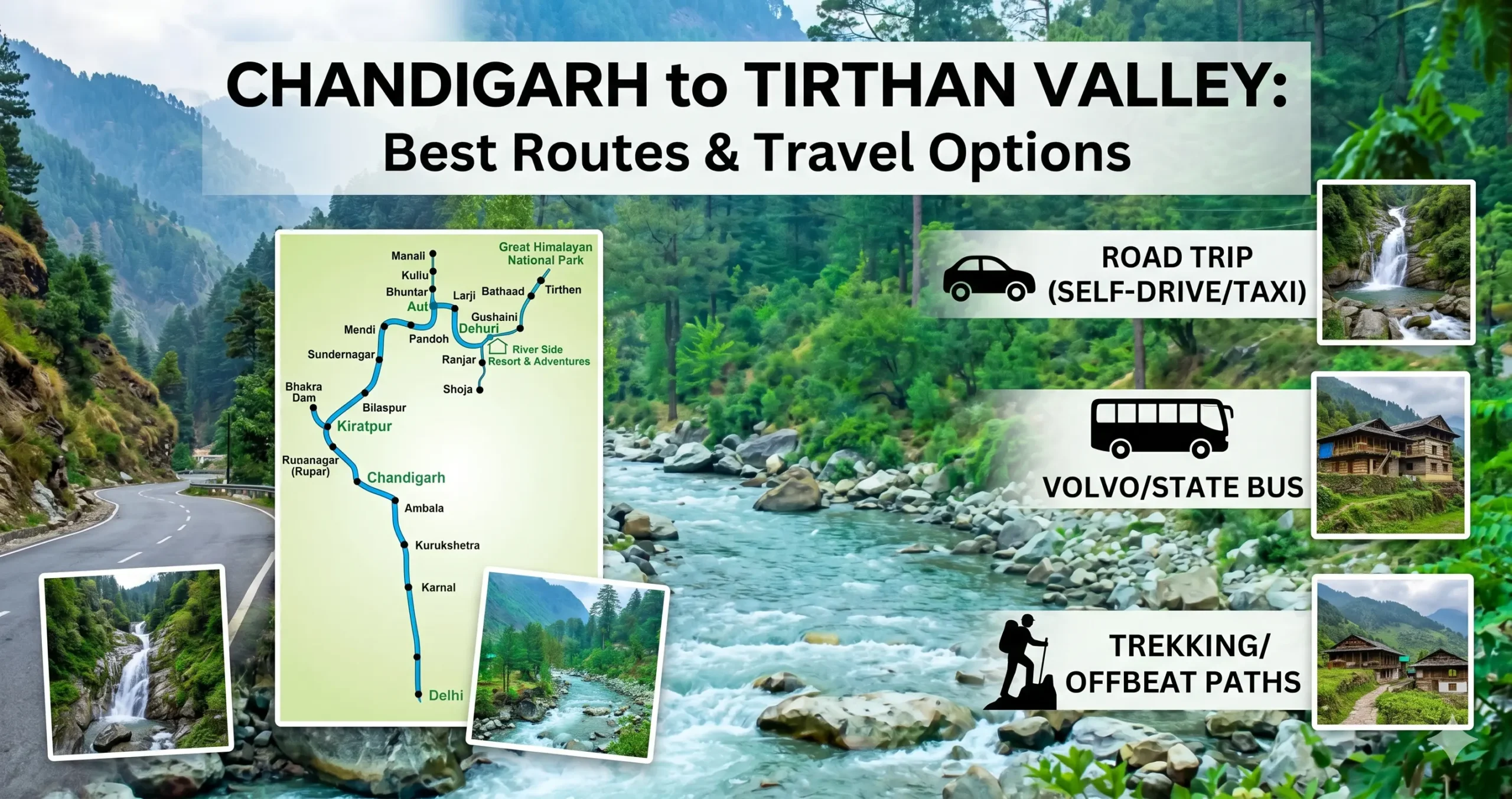
Tirthan Valley is one of the most peaceful and scenic destinations in Himachal Pradesh. Sitting in the Kullu district, it’s known for its clear river, forested hills, quiet villages, and easy access to the Great Himalayan National Park. The journey from Chandigarh suits travellers who want calm mountain landscapes rather than a crowded hill station.
Distance, Time and Cost Up Front
- Distance: 260 km via the Aut highway, or about 300 km over Jalori Pass
- Travel time: 7.5–8.5 hours by car on the fast route; 10–12 hours over the pass
- Self-drive cost: Roughly ₹2,600–₹2,700 in fuel and tolls
- Best mode: Road — private vehicle, taxi, or a bus-plus-transfer combination
The Two Roads to Gushaini
Straight Up NH3 to Aut
Good for: Families, first-timers, and anyone who wants a smooth drive.
Path: Chandigarh → Ropar → Kiratpur Sahib → Bilaspur → Sundernagar → Mandi → Aut → Banjar → Gushaini
Distance: ~260 km | Time: 7.5–8.5 hours
- The Kiratpur–Nerchowk tunnels cut real time off the older alignment
- Smooth four-lane NH3 running all the way to Aut
- A scenic riverside stretch from Aut into the valley
The turn that catches people out: do not enter the Aut tunnel. Take the right turn just before it, toward Banjar. From there it’s roughly 30 km and 1 to 1.5 hours to Gushaini.
Over Jalori Pass via Shimla
Good for: Adventure seekers and experienced mountain drivers.
Path: Chandigarh → Solan → Shimla → Narkanda → Ani → Jalori Pass → Shoja → Jibhi → Banjar → Tirthan Valley
Distance: ~300 km | Time: 10–12 hours
- Crosses Jalori Pass at about 10,800 ft
- Dense forest, waterfalls, and villages like Shoja and Jibhi along the way
The catch: the roads are steep and narrow for long stretches, and the pass closes in winter under heavy snowfall. It’s the longer road in every sense — roughly 40 km further and several hours slower than going via Aut.
Fast Road or High Pass?
| Route | Key stops | Distance | Time | Verdict |
|---|---|---|---|---|
| Via Aut (recommended) | Kiratpur → Mandi → Aut → Banjar | ~260 km | 7.5–8.5 hrs | Safest and fastest, newly upgraded with four-lane tunnels |
| Via Jalori Pass | Shimla → Narkanda → Jalori Pass → Jibhi | ~300 km | 10–12 hrs | Gorgeous, but steep and only for confident drivers |
What the drive costs: at 260 km and 12 km/L with petrol near ₹110/L, fuel comes to about ₹2,400, plus ₹200–₹300 in tolls — roughly ₹2,600–₹2,700 one way on the Aut route.
The Aut Drop: Doing It by Bus
No bus runs directly into Tirthan Valley, so the approach is to get dropped at Aut and transfer.
Leg 1 — Chandigarh to Aut
- Board any Manali-bound Volvo or HRTC service from ISBT Sector 43 and ask for a drop at Aut
- Time: 6 to 7 hours
- Cost: ₹600–₹1,200 on a Volvo; ordinary non-AC services on the same leg cost noticeably less
Leg 2 — Aut to Tirthan Valley
- Local bus on the Banjar or Gushaini route: ₹60–₹80
- Taxi: ₹1,200–₹1,500
If you’re carrying luggage or arriving late in the evening, the taxi is worth it for this last stretch — local buses thin out after dark. Bookings go through HRTC, Redbus, Zingbus, or AbhiBus.
Why Neither Rail Nor Air Helps Here
By train: there is no station anywhere near Tirthan Valley. Kiratpur Sahib is the closest railhead on the route, but it still leaves almost the whole journey to be covered by road, so from Chandigarh there is no rail advantage at all.
Easy rail ticket booking online
By air: the nearest airport is Bhuntar, about 50 to 60 km away, with a two-hour taxi transfer via Aut. Flights are limited, expensive, and weather-dependent, which leaves road travel as the only dependable option.
Picking a Way to Travel
| Mode | Approach | Time | Cost (one way) | Good for |
|---|---|---|---|---|
| Personal car / SUV | Self-drive via NH3 and Aut | 7.5–8.5 hrs | ₹2,600–₹2,700 (fuel & tolls) | Families who want to stop at riverside cafés along the way |
| Private taxi | Direct from Chandigarh | 7.5–8.5 hrs | ₹6,000–₹8,000 | A door-to-door drop with zero hassle |
| Bus (premium combo) | Volvo to Aut, then taxi | 8.5–9.5 hrs | ₹800 bus + ₹1,200 cab | Couples or small groups wanting comfort |
| Bus (budget combo) | Ordinary bus to Aut, then local bus | 9–10 hrs | ₹600–₹800 | Solo travellers on a tight budget |
Month by Month in the Valley
- March–April: Pleasant weather, greening hills, and a quiet valley before the crowds.
- May–June: The busiest stretch, with comfortable weather for trekking, camping, fishing, and family trips.
- July–August: Lush and green, but rain makes roads slippery and raises landslide risk — check conditions before setting out.
- September–November: Arguably the best window, with clear skies, smaller crowds, and excellent mountain views.
- December–February: Peaceful and cold. Snow is likely at Jalori Pass, though the lower villages usually stay accessible.
Side Trips from Tirthan
Within easy reach, on this side of Jalori Pass:
- Jibhi — about 10 km from Banjar, and the natural add-on to any Tirthan trip
- Shoja — a small village on the climb toward the pass
- Jalori Pass and Serolsar Lake — the lake is a short forest walk from the top of the pass
- Sainj Valley — the other, even quieter Great Himalayan National Park approach
Further afield, back down through Aut and up the other valley:
- Kasol and Manikaran — roughly 60 to 70 km away in Parvati Valley, better treated as a separate leg than a day trip
- Manali — about 70 km on from Aut, if your itinerary has room
Fuel, Cash and Signal
Fuel is available at Chandigarh, Kiratpur Sahib, Bilaspur, Sundernagar, Mandi and Aut. Fill up at Mandi or Aut before turning into the valley, where pumps are scarce.
ATMs are reliable at Chandigarh, Bilaspur, Mandi and Banjar. Carry cash beyond that — smaller village shops, cafés and taxis often don’t take digital payments.
Mobile coverage holds up along the highway but weakens inside the valley. Jio works in most villages, Airtel in several, and BSNL often does best in the remoter pockets. Many homestays have Wi-Fi, though speeds vary and the deeper parts of the valley can drop to nothing.
Places to Stay Along the Tirthan
The valley runs from budget hostels and family guesthouses up through boutique homestays, riverside cottages and eco-resorts to a few luxury camps. Riverside properties are the draw and the first to fill, so book ahead for summer weekends and holiday periods.
What to Eat in the Valley
Local cafés and homestays are the best places to try Himachali cooking, and Tirthan’s river trout is the regional specialty worth planning a meal around. Also look for siddu, babru, madra, chha gosht, aktori, sepu vadi, mittha, and a full Himachali dham if you happen to be somewhere serving one.
Budgeting a Two-Day Trip
| Travel style | Estimated cost (2 days) |
|---|---|
| Budget backpacker | ₹4,000–₹6,000 |
| Mid-range couple | ₹8,000–₹14,000 |
| Family trip | ₹15,000–₹25,000 |
| Luxury stay | ₹25,000+ |
Where you land depends mostly on accommodation and whether you drive, taxi, or bus it.
A Few Ground Rules for the Valley
- This is an eco-sensitive zone — don’t litter, and keep music low
- Trout fishing needs a permit, which your homestay can usually arrange
- Entry into the Great Himalayan National Park requires permission, though the valley itself needs none
- The Aut–Banjar–Gushaini road is narrow and largely single-lane; take it slowly, especially after dark
Worth the Drive?
Getting from Chandigarh to Tirthan Valley is less a simple drive and more a shift from city noise into Himalayan quiet. The NH3 route through Aut is the sensible choice for almost everyone — faster, safer, and about 40 km shorter. Save the Jalori Pass climb for when you have a spare day and genuinely want the drive itself to be the point. Either way you land somewhere unspoiled and a world away from the commercial hill stations.
Things People Ask Before Going
1. What is the distance between Chandigarh and Tirthan Valley?
About 260 km via Mandi and Aut, or roughly 300 km if you go over Jalori Pass.
2. What is the best route from Chandigarh to Tirthan Valley?
Via Mandi and Aut on NH3: Chandigarh → Kiratpur Sahib → Bilaspur → Mandi → Aut → Banjar → Tirthan Valley. It has the smoothest roads and the shortest travel time.
3. How long does it take to reach Tirthan Valley from Chandigarh?
- By car or taxi via Aut: 7.5 to 8.5 hours
- By bus combination: 8.5 to 10 hours
- Over Jalori Pass: 10 to 12 hours
4. Is there a direct bus from Chandigarh to Tirthan Valley?
No. Take a bus to Aut, then a local bus or taxi on to Banjar and Gushaini.
5. How do I get from Aut to Tirthan Valley?
Either a local HRTC bus toward Banjar or Gushaini, or a private taxi. The distance is around 30 km and takes about 1 to 1.5 hours.
6. Is the Jalori Pass route safe?
It’s scenic but demanding — steep, narrow, suited to experienced drivers, and closed in winter under heavy snowfall. It’s also about 40 km longer than the Aut route.
7. What is the best time to visit Tirthan Valley?
March to June for pleasant weather, and September to November for clear views and fewer crowds. Peak monsoon and deep winter are both worth avoiding.
8. How does Tirthan Valley compare with Manali?
Tirthan is far less commercialised and much quieter, with the trade-off being fewer facilities, less nightlife, and no real shopping. If you want nature over amenities, Tirthan suits better; if you want a full tourist infrastructure, Manali does.
9. Are the roads from Aut to Tirthan Valley safe?
Yes, with care. They’re narrow and mostly single-lane, so drive slowly, use your horn on blind bends, and avoid the stretch after dark if you can.
10. What is the nearest railway station?
There is none nearby. Kiratpur Sahib is the closest railhead on the route, but it saves so little of the journey that road travel from Chandigarh is the practical choice.
11. What is the nearest airport?
Bhuntar, about 50 to 60 km away, with a two-hour taxi transfer. Flights are limited and unreliable in poor weather.
12. Can I do this as a weekend trip from Chandigarh?
It works as a two to three day trip: travel up, a full day in the valley, then return. A single overnight is too tight given the eight-hour drive each way.
13. Do I need a permit to visit Tirthan Valley?
Not for the valley itself. Entry into the Great Himalayan National Park does require permission, and trout fishing needs a separate permit.
14. Is it suitable for families and first-time travellers?
Yes, provided you take the Aut route, which is well-maintained and undemanding compared with the pass.
15. What is the mobile network like in Tirthan Valley?
Patchy. Jio and BSNL tend to work best; expect weak or no signal in the remoter parts of the valley.
Nearby Guides Worth a Look
- Chandigarh to Jibhi — 10 km from Banjar, the easiest add-on to this trip
- Chandigarh to Kasol — the Parvati Valley alternative, same road as far as Aut
- Chandigarh to Tosh
- Manikaran to Chandigarh
Travel Information Disclaimer
The information provided on this page is for general informational purposes only. While we try to keep travel details accurate and up to date, routes, road conditions, fares, timings, weather, transport availability, permits, and local regulations may change without notice. Readers should verify all essential details with official sources, local authorities, or transport providers before travelling. We are not responsible for any loss, delay, inconvenience, or issue arising from the use of this information.