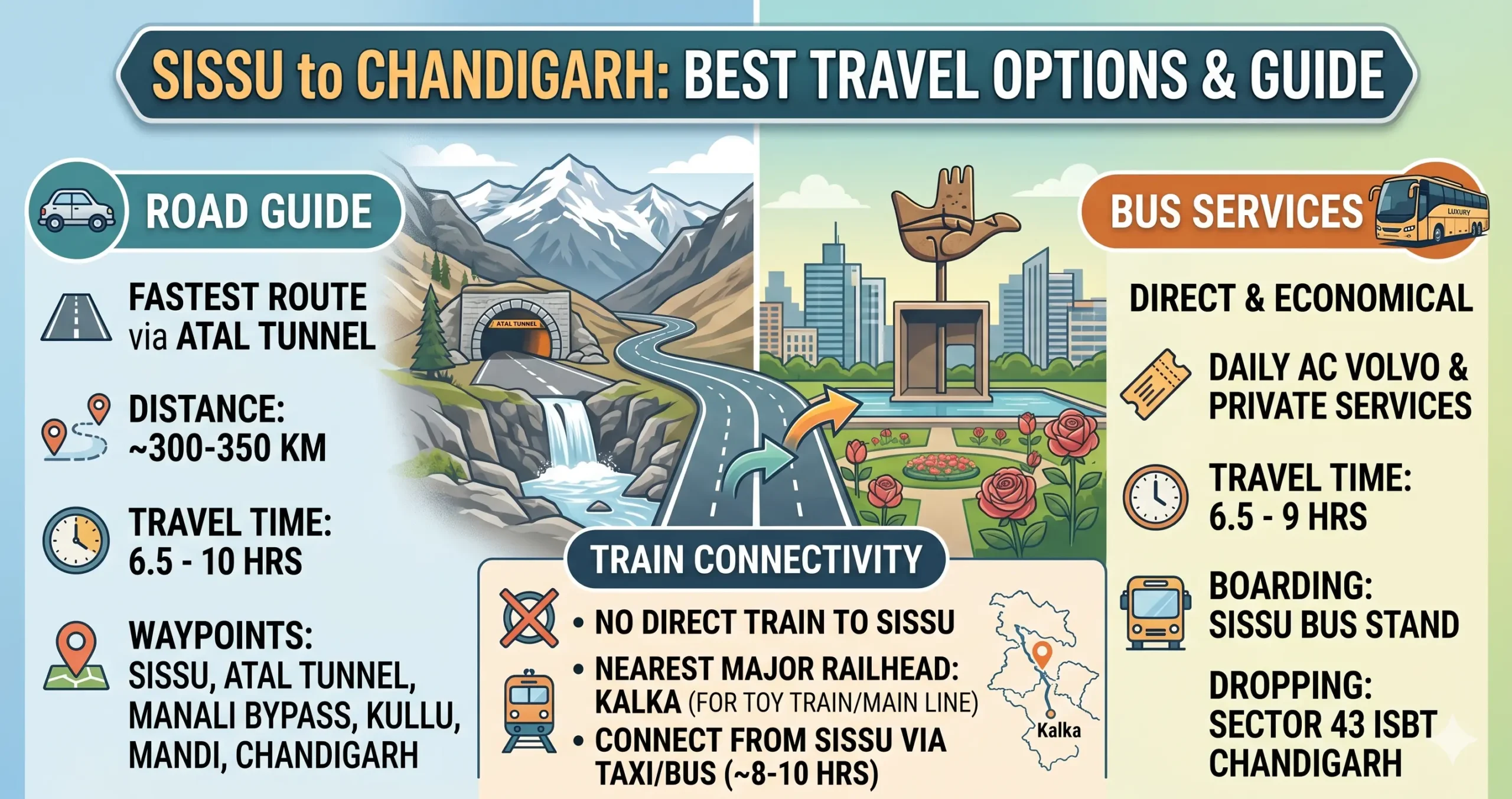
The trip from Sissu, a scenic village in Himachal Pradesh’s Lahaul Valley, to Chandigarh spans roughly 300 to 350 km, depending on the route chosen. Because the journey involves descending from high altitude through tunnels, mountain highways, and river valleys before reaching Punjab’s plains, it typically takes between 9 and 14 hours. This guide sets out the available road, bus, rail, and air options along with the practical details needed to plan the trip.
Trip Overview
| Detail | Information |
|---|---|
| Distance | 300–350 km |
| Road travel time | 9–14 hours |
| Fastest, safest route | Via Atal Tunnel and Mandi |
| Nearest airport | Kullu–Manali Airport (near Bhuntar) |
| Rail access | None nearby — Chandigarh is the practical hub |
| Recommended overall | Atal Tunnel and Mandi route |
Driving There: Car and Taxi Options
Driving offers the greatest flexibility and allows travelers to fully experience the transition from the rugged Himalayas to the smooth expressways leading into Chandigarh.
Route One: Via Atal Tunnel and Mandi
This is generally the fastest and safest option, particularly outside the summer months.
Path: Sissu → Atal Tunnel → Manali Bypass → Kullu → Shamshi → Bhuntar → Mandi → Bilaspur → Kiratpur Sahib → Ropar → Chandigarh
- Distance: Approximately 300–320 km
- Time: 9–11 hours
- Road conditions: The stretch from Sissu to the Atal Tunnel involves smooth, high-altitude mountain roads generally well-maintained by the Border Roads Organisation. After the tunnel, road quality improves significantly, with scenic sections along the Beas River and wide highways near Kiratpur Sahib.
Highlights along the way include the Atal Tunnel itself, the Beas River valley, Kullu Valley scenery, Pandoh Lake, and the Bilaspur hill stretches. This route is the most reliable option year-round, especially valuable during winter when Rohtang Pass is closed.
Route Two: Via Rohtang Pass (The Classic Mountain Route)
A more scenic, seasonal alternative suited to adventure travelers.
Path: Sissu → Khoksar → Gramphu → Rohtang Pass → Manali → Kullu → Bhuntar → Mandi → Chandigarh
- Distance: Approximately 340–350 km
- Time: 12–14 hours
- Road conditions: Steep mountain roads with seasonal accessibility, rough patches near Rohtang, and heavy tourist traffic during summer.
Highlights include Rohtang Pass itself, glacier viewpoints, snow walls in early summer, and panoramic Himalayan scenery. This route is best suited to summer travel and scenic exploration rather than a quick transit.
Comparing the Two Routes
| Route | Key Waypoints | Time | Verdict |
|---|---|---|---|
| Via Atal Tunnel (recommended) | Sissu → Atal Tunnel → Kullu → Mandi | ~9–11 hrs | Safest and fastest option to Chandigarh |
| Via Rohtang Pass | Sissu → Khoksar → Rohtang Pass → Manali | 12–14 hrs | Scenic detour, seasonal, more driving time required |
Bus Options for This Route
Growing tourism infrastructure in the Lahaul region has improved bus connectivity from Sissu to Chandigarh.
Premium Volvo and semi-sleeper buses
- Operators include Zingbus, Abhibus, and HRTC.
- Boarding points: Sissu market area, Zostel Sissu pickup points, or nearby Manali transit stops.
- Drop-off points in Chandigarh: ISBT Sector 43 or Tribune Chowk.
- Travel time: Approximately 6.5–10 hours, depending on traffic and weather.
- Fare: Around ₹1,699–₹1,800 or more.
These premium AC buses work well for travelers wanting a comfortable overnight or relaxed journey without the fatigue of driving.
Is Train Travel an Option?
Not really. Sissu has no railway connectivity, and while Joginder Nagar is technically closer, it’s only served by narrow-gauge mountain railways that aren’t practical for fast transit. Chandigarh remains the nearest useful broad-gauge rail hub, meaning road transport stays the primary way to complete this journey.
Book Your Train Tickets Online
Flying via Bhuntar: The Fastest Option
Nearest airport: Kullu–Manali Airport, near Bhuntar
Strategy:
- Drive from Sissu to Bhuntar Airport — approximately 4–5 hours.
- Take a direct flight to Chandigarh — approximately 1 hour.
This is the fastest overall option for travelers with limited time, though flights can be pricier, weather delays are fairly common, and seasonal availability can fluctuate.
Comparing the Travel Options
| Travel mode | Strategy | Travel time | Estimated cost | Best suited for |
|---|---|---|---|---|
| Personal SUV/car | Via Atal Tunnel and Mandi | 9–11 hrs | Fuel and tolls | Families and travelers wanting flexibility for stops |
| Premium AC bus | Direct Volvo semi-sleeper | ~6.5 hrs | ₹1,699–₹1,800 | Comfort-focused travelers wanting a hassle-free ride |
| Flight combination | Taxi to Bhuntar + flight | 5–6 hrs total | ₹5,000+ | Time-crunched travelers |
Best Time of Year to Travel
| Season | Travel conditions |
|---|---|
| Summer (May–June) | Pleasant weather, clear skies, and excellent road conditions |
| Monsoon (July–September) | Travel possible via Atal Tunnel, though rainfall may cause landslides and delays |
| Autumn (October–November) | Cool weather, clear mountain views, and lighter traffic |
| Winter (December–March) | Atal Tunnel remains the preferred route, though snowfall and icy roads call for caution |
Recommended Stops Along the Way
Road travelers can enjoy several excellent stops between Sissu and Chandigarh:
- Atal Tunnel viewpoints
- Kullu Valley cafés
- Pandoh Lake tea stops
- Bilaspur highway dhabas
- Kiratpur Sahib refreshment stops
Tips for a Smoother Journey
- Start early to avoid traffic near Manali and Chandigarh.
- Carry warm clothing, since temperatures around Sissu run considerably lower than in Chandigarh.
- Keep snacks, drinking water, and essential medicines on hand for the long drive.
- Refuel before leaving the Lahaul region.
- Download offline maps, as mobile connectivity can be limited in parts of the mountains.
- Drive carefully through tunnels and mountain roads, especially during rain or snowfall.
Driving Safely Through the Himalayas
- Follow speed limits and avoid unnecessary overtaking.
- Use lower gears on steep descents to reduce brake wear.
- Maintain a safe distance from other vehicles on winding stretches.
- Avoid driving late at night in mountain areas due to reduced visibility.
- Watch for falling rocks, construction zones, and shifting weather.
- Check official traffic advisories before setting out.
Fuel and Essential Services
Travelers can find fuel stations and essential services at several major towns along the route.
Common locations include:
- Manali
- Kullu
- Bhuntar
- Mandi
- Bilaspur
- Kiratpur Sahib
These towns also offer ATMs, restaurants, pharmacies, vehicle repair workshops, and accommodation options if you plan to break your journey.
Staying Connected Along the Way
Mobile coverage varies significantly throughout the route.
- Sissu and nearby high-altitude areas may experience limited network availability.
- BSNL and Jio generally provide better coverage in remote Himalayan regions.
- Network quality improves considerably after reaching Manali and remains stable towards Chandigarh.
- Download navigation maps and important documents before leaving Sissu.
Places to Stay Along the Route
If you prefer breaking your journey into two days, several towns offer comfortable accommodation.
For travelers splitting the journey into two days, comfortable accommodation is available in Sissu, Manali, Kullu, Mandi, and Bilaspur, ranging from budget guesthouses to boutique stays and luxury resorts.
Responsible Tourism
Help preserve the fragile Himalayan ecosystem by following responsible travel practices.
- Avoid littering and use designated waste bins.
- Respect local customs and village communities.
- Minimize the use of single-use plastics.
- Do not disturb wildlife or damage natural surroundings.
- Support local cafés, homestays, and small businesses whenever possible.
Final Verdict: What’s the Best Way to Travel?
- Best Overall Route: Via Atal Tunnel & Mandi
- Best Scenic Route: Via Rohtang Pass
- Best for Adventure Travelers: Via Kaza & Shimla
- Best Public Transport Option: Premium Volvo Bus
- Fastest Overall Transit: Bhuntar Flight Combination
For most travelers, the Atal Tunnel and Mandi route offers the best combination of safety, scenery, and speed while descending from the Lahaul Valley into the plains around Chandigarh. Those wanting a more scenic, seasonal drive might consider the Rohtang Pass route instead. A premium Volvo bus remains the top public transport choice, while a flight via Bhuntar offers the fastest overall transit for travelers short on time.
Frequently Asked Questions (FAQs) – Sissu to Chandigarh Travel Guide
1. What is the distance between Sissu and Chandigarh?
The road distance between Sissu and Chandigarh ranges from approximately 300 km to 350 km, depending on the route taken.
2. How long does it take to travel from Sissu to Chandigarh?
A direct road journey usually takes around 9 to 11 hours via the Atal Tunnel route. Alternative routes can take longer depending on weather and road conditions.
3. Which is the best route from Sissu to Chandigarh?
The most recommended route is:
Sissu → Atal Tunnel → Manali → Kullu → Mandi → Kiratpur Sahib → Chandigarh
This route is the safest, fastest, and remains operational for most of the year.
4. Is the Atal Tunnel route open throughout the year?
Yes, Atal Tunnel is designed for all-weather connectivity and usually remains open year-round, except during extreme weather or maintenance closures.
5. Is the Rohtang Pass route still usable?
Yes, the Rohtang Pass route is accessible during summer months when the pass opens. However:
- It is slower
- Seasonal
- More challenging for drivers
Most travelers now prefer the Atal Tunnel route.
6. Are there direct buses from Sissu to Chandigarh?
Yes, several private Volvo and semi-sleeper buses operate between Sissu/Manali and Chandigarh, especially during tourist season.
7. Which bus operators run on this route?
Popular operators include:
- Zingbus
- Heera Himachal Holidays
These operators offer AC Volvo and semi-sleeper buses.
8. What is the bus fare from Sissu to Chandigarh?
Bus ticket prices generally range between:
- ₹1,699
- ₹1,800+
depending on the operator, season, and seat category.
9. Which Chandigarh bus stand do buses arrive at?
Most buses arrive at:
- ISBT Sector 43
- Tribune Chowk
in Chandigarh.
10. Is there a train from Sissu to Chandigarh?
No. Sissu does not have railway connectivity, and train travel is not considered practical for this route.
11. Which is the nearest airport to Sissu?
The nearest airport is:
- Kullu–Manali Airport
located near Bhuntar.
12. Can I fly from Bhuntar to Chandigarh?
Yes, travelers can drive from Sissu to Bhuntar Airport and take a flight to Chandigarh, subject to weather and flight availability.
13. Is the road from Sissu to Chandigarh safe during winter?
Yes, the Atal Tunnel route is generally safe during winter, but:
- Snowfall can slow traffic
- Black ice may form early morning
- Weather updates should always be checked before departure
14. Are there good food stops on the route?
Yes, excellent stops include:
- Manali cafés
- Kullu Valley restaurants
- Pandoh Lake tea stalls
- Bilaspur dhabas
- Kiratpur highway food courts
15. Is a same-day trip from Sissu to Chandigarh possible?
Yes, many travelers complete the journey in one day by:
- Private car
- Volvo bus
- Flight combination
However, early morning departures are strongly recommended for road travelers.
Explore More Himalayan Routes
While Sissu is famous for its waterfalls, mountain scenery, and easy access to the Atal Tunnel, it also serves as a gateway to some of Himachal Pradesh’s most spectacular high-altitude destinations. Travelers planning further adventures can explore our guides on Sissu to Manali, Keylong to Chandigarh, Manali to Chandigarh, Chandigarh to Spiti Valley, and Delhi to Sissu. At ReachByRoutes, we provide detailed road, bus, and travel guides to help you explore the Himalayas with confidence.
Disclaimer: Distances, travel times, fares, transportation schedules, and road conditions mentioned in this guide are approximate and may change over time. Travelers are encouraged to verify the latest information through official transport operators and local authorities before departure.