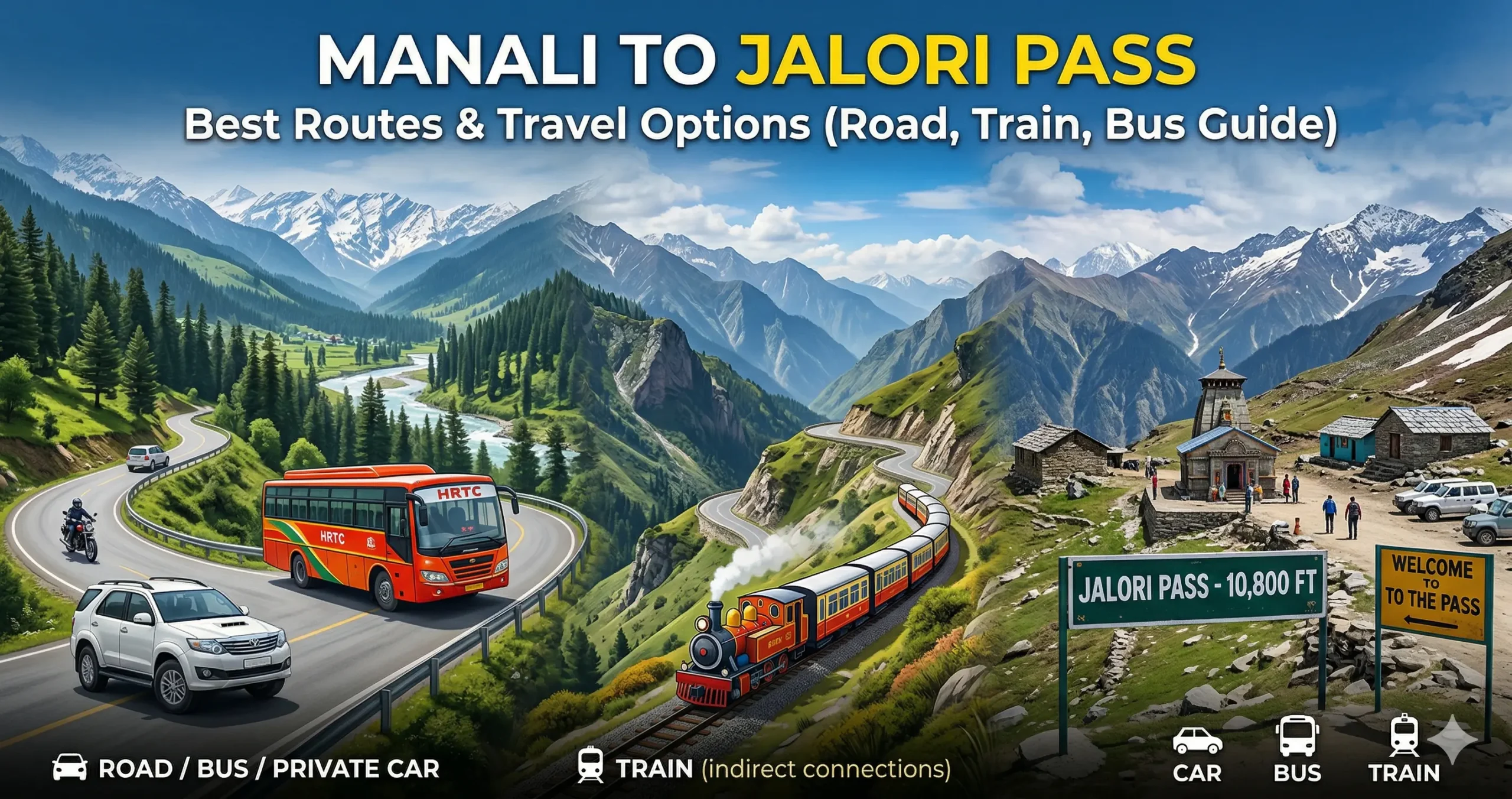
The drive from Manali to Jalori Pass is one of the more thrilling road trips in Himachal. You start by leaving the busy Kullu Valley, then climb steeply into the quieter, forested ridges of the Banjar Valley. It’s a short trip in distance, but a big change in scenery.
Here’s what you need to know.
Overview and Quick Facts
- Distance: Approximately 110–115 km via the main route; ~120 km via the Naggar alternative.
- Typical travel time: 4–5.5 hours by car, depending on route; 6–7 hours using buses and shared taxis.
- Altitude: Jalori Pass sits near ~3,300 m (about 10,800 ft).
- Road standard: NH3/major highway till Bhuntar/Aut; narrower valley roads and steep, winding sections beyond Aut/Jibhi.
- Best seasons: April–June and September–November for clear weather; avoid winter unless prepared for snow closures.
Popular Road Routes from Manali to Jalori Pass
Driving is the best and most adventurous way to reach Jalori Pass.
Main Highway via Aut (Fastest and Recommended)
Route: Manali → Kullu → Bhuntar → Aut → Banjar → Jibhi → Shoja → Jalori Pass
- Distance: ~110 km
- Time: 4–5 hours
How the road changes:
- Manali → Aut: Smooth NH3 highway
- Aut → Jibhi: Narrow valley road along Tirthan River
- Jibhi → Jalori Pass: Very steep, sharp bends, rough patches
Why Choose This Route?
- Fastest and most direct
- Well-connected till Banjar
- Ideal for experienced drivers
One thing to remember: take the right turn before the Aut Tunnel, not through it.
Left Bank via Naggar (Scenic Alternative)
Route: Manali → Prini → Naggar → Patlikuhal → Kullu → Aut → Banjar → Jibhi → Jalori Pass
- Distance: ~120 km
- Time: 5–5.5 hours
Why Choose This Route?
- Less traffic than main highway
- Traditional Himachali villages & orchards
- More scenic and peaceful
Aut vs. Naggar, at a Glance
| Route | Key Stops | Distance | Time | Best For |
|---|---|---|---|---|
| Via Aut (fast) | Bhuntar → Aut → Banjar → Jibhi → Shoja | ~110 km | 4–5 hrs | Speed, direct travel |
| Via Naggar (scenic) | Naggar → Kullu → Aut → Banjar → Shoja | ~120 km | 5–5.5 hrs | A quieter, prettier drive |
Bus & Shared Transport (Budget Travel)
There’s no direct bus to Jalori Pass, so you’ll need to travel in stages.
- Step 1 — Manali to Aut: Board a bus heading toward Mandi or Chandigarh. This takes about 3 hours and costs around ₹150.
- Step 2 — Aut to Banjar/Jibhi: Switch to a local HRTC bus. This leg takes 1 to 1.5 hours and costs about ₹60.
- Step 3 — Banjar/Jibhi to Jalori Pass: From here, take a shared cab, since local buses are rare on this last stretch. It takes about an hour and costs ₹100–150.
Total: around 6–7 hours and ₹350–400. This works well for backpackers and anyone traveling on a budget.
Train and Flight Options
- Nearest Airport: Kullu–Manali Airport
- Nearest Railway Station: Joginder Nagar Railway Station
Road travel is the only viable option.
Travel Options Comparison Table
| Mode | Time | Cost (one way) | Best For |
|---|---|---|---|
| Personal SUV or car | 4–5 hrs | Fuel ~₹1,200 | Those who want full freedom (some hill-driving experience helps) |
| Private taxi | 4–5 hrs | ₹4,000–5,500 | A safer, more comfortable choice if you’re not confident on steep inclines |
| Bus + shared cab | 6–7 hrs | ~₹350–400 | Budget travelers who want a genuine local travel experience |
Picking the Right Season
- April to June: Clear skies and pleasant temperatures.
- September to November: Stable weather with good visibility.
- July to August (monsoon): Watch for landslides and washed-out sections — check local updates before heading out.
- December to March (winter): Heavy snow can close the pass, and you’d need chains and winter driving experience.
Local Services and Facilities
- Fuel: Available in Kullu and Bhuntar. There are no fuel stations after Aut, so fill up before you leave.
- Food and stay: Banjar and Jibhi both have cafes, tea stalls, and guesthouses. Jalori Pass itself has only basic, seasonal facilities.
- Medical help: Basic clinics exist in the larger towns. It’s worth carrying your own medicines just in case.
Suggested Itineraries
- Day trip (from Manali): Start early, reach Jalori Pass by midday, return to Manali by evening. Best for well-driven vehicles.
- Overnight trip: Drive to Jibhi or Shoja, stay in a homestay, early morning visit to Jalori Pass the next day.
- Photography & trekking: Combine Jalori Pass with a trek to Serolsar Lake for a full-day nature experience.
Before You Leave for Jalori Pass
- Fill up your tank in Bhuntar or Kullu before the valley road starts.
- Carry enough cash — ATMs are hard to find past Banjar.
- Pack layered clothing, something for rain, and comfortable walking shoes.
- Download offline maps and share your route with someone.
- Check HRTC bus timings and the weather forecast before you go.
A Few More Things to Keep in Mind
- The climb after Jibhi is steep and needs careful, confident driving.
- Jalori Pass closes from December to March due to heavy snow.
- Use engine braking (a low gear) while going downhill, rather than relying only on your brakes.
- Mobile network gets weak in the upper stretches near the pass.
Choosing Your Way to Jalori Pass
The drive from Manali to Jalori Pass mixes easy highway driving with real mountain adventure.
- Want speed? → Take NH3 via Aut
- Want scenic beauty? → Choose the Naggar route
- Want adventure? → Enjoy the Jibhi–Shoja–Jalori climb
This route is one of the most rewarding drives in Himachal, offering everything from riverside views to high-altitude thrills.
Questions Travellers Ask
1. What is the distance between Manali and Jalori Pass?
The distance between Manali and Jalori Pass is approximately 110 to 115 kilometers.
2. How much time does it take to travel from Manali to Jalori Pass?
- By Car/Taxi: 4 to 5 hours
- By Bus + Cab: 6 to 7 hours
Travel time depends on road and weather conditions.
3. What is the best route from Manali to Jalori Pass?
The most preferred route is: Manali → Kullu → Bhuntar → Aut → Banjar → Jibhi → Shoja → Jalori Pass
4. Is there an alternative scenic route?
Yes, via Naggar. This route is more scenic but slightly longer and slower.
5. Is the road from Manali to Jalori Pass safe?
Yes, but it requires experienced hill driving skills, since there are narrow roads after Aut, a very steep climb from Jibhi onward, and sharp hairpin bends.
6. Can beginners drive to Jalori Pass?
Not recommended for beginners, especially beyond Jibhi. The steep gradient and narrow roads can be challenging.
7. Is there a direct bus from Manali to Jalori Pass?
No direct bus is available. You need to travel in parts: Manali → Aut → Banjar/Jibhi → Jalori Pass.
8. What is the cheapest way to reach Jalori Pass?
The cheapest option is a bus from Manali to Aut, a local bus to Banjar/Jibhi, then a shared cab to Jalori Pass — a total cost of ₹350–₹400.
9. Are shared taxis available for Jalori Pass?
Yes, shared taxis (Bolero/Sumo) are available from Banjar and Jibhi to Jalori Pass.
10. Which vehicles are best for this route?
SUVs or high ground clearance vehicles are ideal. Small cars can manage but require skilled driving.
11. Is Jalori Pass open throughout the year?
No. It’s closed from December to March due to heavy snowfall, and open April to November, weather dependent.
12. What is the best time to visit Jalori Pass?
April to June brings pleasant weather, and September to November brings clear views. Winter visits depend on snow conditions.
13. Are petrol pumps available on the route?
Available at Kullu and Bhuntar. No fuel stations after Aut.
14. Is mobile network available on the route?
Network is available till Banjar, becoming weak or unavailable near Jalori Pass.
15. What should I keep in mind while descending from Jalori Pass?
Use engine braking (low gear) instead of continuous braking. This prevents brake failure on steep downhill roads.
Travel Information Disclaimer
Road conditions, weather, and local services can change without notice. Always check current conditions with local authorities or transport operators before you travel. Mountain driving carries real risks, so drive cautiously, carry emergency supplies, and use a suitable vehicle for the terrain.