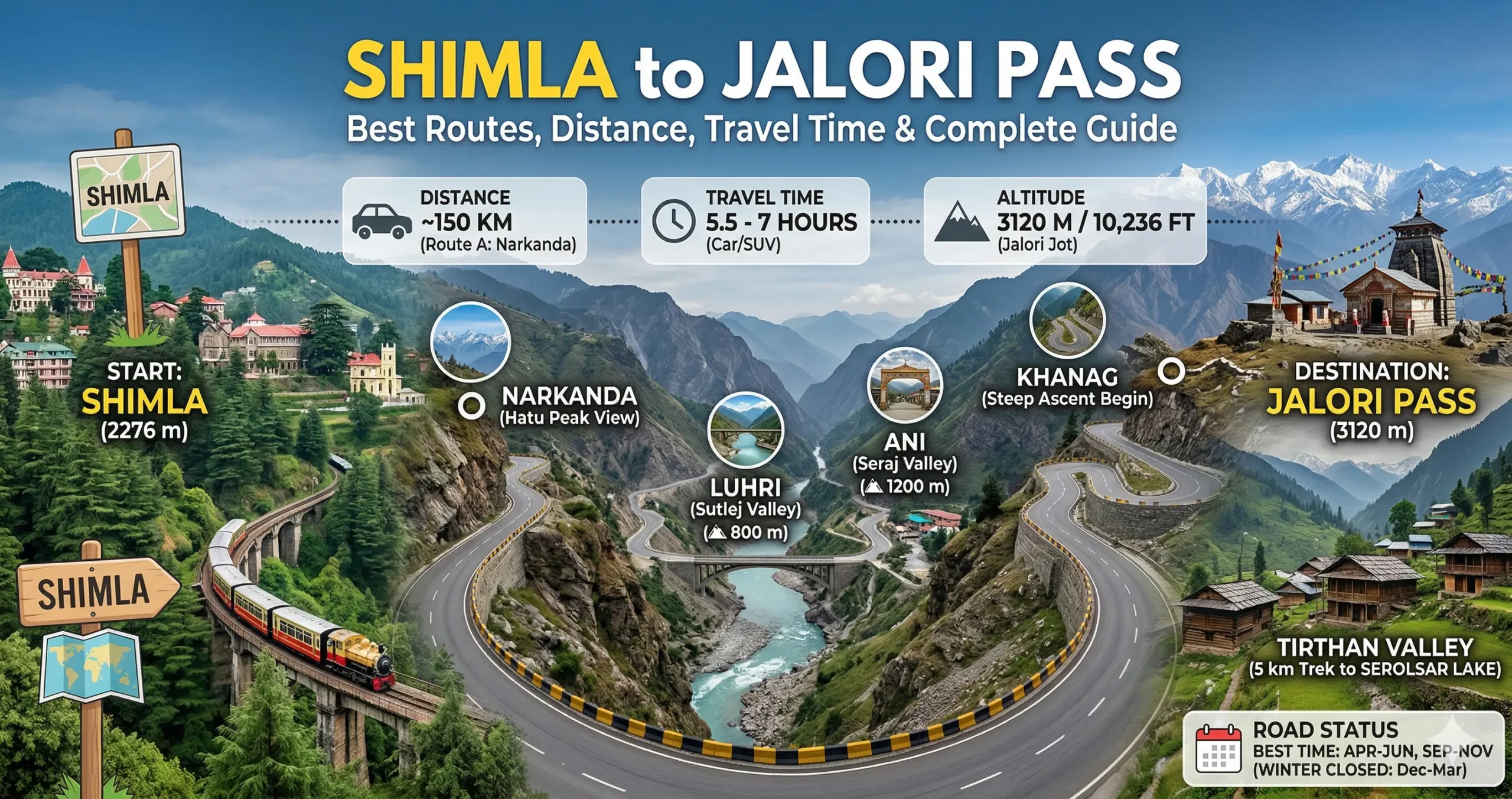
The drive from Shimla to Jalori Pass is one of the most dramatic in Himachal Pradesh. You leave the cool pine forests of Shimla, drop down into the warm Sutlej valley, and then climb back up to a stunning pass at 10,800 ft. It’s a journey of real contrasts, and it’s worth planning well.
Here’s what you need to know.
- Distance: ~150–165 km
- Travel Time: 5.5 to 7 hours (road)
- Best Mode: Road (car or bus)
This guide covers all major routes, alternative bypasses, and transport options so you can choose the best way to reach Jalori Pass.
Best Road Routes (Car / Bike / Taxi)
Driving is the most scenic and flexible way to experience this journey. However, expect steep gradients, narrow roads, and sharp hairpins, especially near the pass.
The Popular Way: Via Narkanda
Route: Shimla → Kufri → Narkanda → Kingal → Luhri → Ani → Khanag → Jalori Pass
- Distance: ~150 km
- Time: 5.5–6.5 hours
Road Conditions:
- Shimla → Narkanda: Excellent NH5 highway
- Narkanda → Luhri: Steep descent to Sutlej River
- Luhri → Jalori Pass: Narrow, steep, partially rough
Most travelers take this route, and it’s a good pick for first-timers. You’ll pass great viewpoints, including Hatu Peak, and there are decent places to eat along the way.
A Quieter Way: Via Basantpur and Tattapani
Route: Shimla → Mashobra → Basantpur → Suni / Tattapani → Luhri → Ani → Jalori Pass
- Distance: ~160 km
- Time: 6–7 hours
Highlights:
- Scenic Sutlej riverside drive
- Warmer climate (useful in winter)
- Much less crowded
This route runs alongside the Sutlej River and stays a bit warmer, which helps in winter. It also sees far less traffic than the usual Kufri–Narkanda stretch, so it’s a good option if you’d rather skip the crowds or explore something a little different.
Comparing the Two Routes
| Route | Key Stops | Distance | Time | Best For |
|---|---|---|---|---|
| Via Narkanda (popular) | Kufri → Narkanda → Luhri → Ani | ~150 km | 5.5–6.5 hrs | First-time travelers, reliable roads |
| Via Basantpur (quieter) | Mashobra → Suni → Luhri → Ani | ~160 km | 6–7 hrs | Avoiding traffic, winter travel |
Traveling by Bus (Budget Option)
The Himachal Road Transport Corporation (HRTC) runs buses on this route, though there’s no direct luxury bus all the way to Jalori Pass.
- Step 1 — Shimla to Ani: Take a direct HRTC bus from ISBT Tutikandi. It takes about 5 hours and costs ₹250–300.
- Step 2 — Ani to Jalori Pass: From here, hop on a local bus heading toward Banjar or Jibhi, or take a shared taxi. This last stretch takes 1.5 to 2 hours and costs ₹80–150.
Tip: Sit on the left side of the bus for the best valley views.
Train & Air Travel
- Railway: The famous Kalka–Shimla Railway ends at Shimla. No trains go beyond.
- Airport Options:
- Shimla Airport (Jubbarhatti)
- Kullu Airport (Bhuntar)
Train Ticket Booking Made Easy
Verdict: You must travel by road after reaching Shimla.
Comparing Your Travel Options
| Mode | Time | Cost (one way) | Best For |
|---|---|---|---|
| Personal car or SUV | 5.5–6.5 hrs | Fuel ~₹1,500 | Those who want full freedom on the road (a high ground clearance vehicle is a good idea) |
| Private taxi | ~6 hrs | ₹4,500–6,000 | Anyone who’d rather not drive the steep inclines themselves |
| HRTC bus + shared cab | 7–8 hrs | ~₹400 | Budget travelers who don’t mind letting a local driver handle the tricky parts |
Jalori Pass Season by Season
| Season | Conditions | Recommendation |
|---|---|---|
| April – June | Pleasant weather | Excellent |
| July – August | Heavy rainfall | Travel cautiously |
| September – November | Clear skies & views | Best time |
| December – March | Snowfall, road closures likely | Check road status before travel |
Top Stops Between Shimla and Jalori Pass
- Kufri: Known for mountain views, horse rides, and winter snowfall.
- Narkanda: A beautiful hill station famous for apple orchards and Hatu Peak.
- Luhri: A small riverside town located along the Sutlej River.
- Ani: A peaceful Himachali town and the last major stop before Jalori Pass.
- Khanag: Known for dense forests and spectacular valley views.
What to Expect on the Drive
- Smooth highways until Narkanda.
- Sharp descent toward the Sutlej Valley.
- Narrow mountain roads after Ani.
- Steep hairpin bends near Jalori Pass.
- Occasional landslide-prone stretches during monsoon.
Fuel and Vehicle Preparation
- Refuel in Shimla or Narkanda.
- Carry cash as some remote fuel stations may face network issues.
- Check brakes and tyres before starting.
- Keep drinking water and snacks for the final climb.
Where to Stay Near Jalori Pass
- Jibhi — the most popular base for most travelers.
- Shoja — a quiet mountain village.
- Banjar — good hotel options.
- Forest guest houses — available, but subject to booking.
A Few Important Notes
- Winter closure: Jalori Pass usually shuts down from December to March due to heavy snow.
- Vehicle choice: An SUV or a vehicle with high ground clearance is a good idea.
- The hardest stretch: The climb from Khanag to Jalori Pass is steep, at roughly a 20% gradient.
- Fuel: The last dependable petrol pump is near Narkanda or Rampur.
Which Route Should You Take?
- First-time travelers: Take the Narkanda route
- Avoid traffic / explore offbeat: Choose the Basantpur/Tattapani route
- Budget travelers: Use HRTC bus + shared taxi via Ani
The Shimla to Jalori Pass journey is among the most scenic drives in Himachal Pradesh. Whether you choose the popular Narkanda route or the quieter Tattapani alternative, the trip offers a memorable blend of forests, mountain roads, river valleys, and panoramic viewpoints. Travelers seeking flexibility should drive, while budget-conscious visitors can comfortably combine HRTC buses with local taxis. Planning ahead, checking weather conditions, and starting early will help ensure a safe and enjoyable trip.
Questions Travellers Ask
1. What is the distance from Shimla to Jalori Pass?
The distance is approximately 150 to 165 km, depending on the route you choose via Narkanda or Tattapani.
2. How long does it take to travel from Shimla to Jalori Pass?
The journey takes around 5.5 to 7 hours by car and 7 to 8 hours by bus, depending on traffic, road conditions, and weather.
3. What is the best route from Shimla to Jalori Pass?
The best and most popular route is via Narkanda → Luhri → Ani → Jalori Pass, offering smooth roads and scenic views.
4. Is the road from Shimla to Jalori Pass safe for driving?
Yes, the route is generally safe, but the stretch from Khanag to Jalori Pass is steep, narrow, and requires careful driving, especially for beginners.
5. Are there direct buses from Shimla to Jalori Pass?
No, there are no direct buses. You can take a bus operated by Himachal Road Transport Corporation to Ani and then continue via local transport or taxi.
6. What is the cheapest way to reach Jalori Pass from Shimla?
The cheapest option is to travel by HRTC bus to Ani and then take a shared taxi, costing around ₹300–₹500 total.
7. Is Jalori Pass open throughout the year?
No, Jalori Pass is usually closed from December to March due to heavy snowfall.
8. Can beginners drive from Shimla to Jalori Pass?
Beginners can drive until Ani comfortably, but the final climb to Jalori Pass is challenging and best handled by experienced drivers.
9. Which is the best time to visit Jalori Pass?
The ideal time is April to June and September to November, when the weather is pleasant and roads are clear.
10. Are fuel stations available on the route?
Fuel stations are available near Shimla and around Narkanda, but limited afterward, so it’s recommended to refuel in advance.
11. Is the Tattapani route better than the Narkanda route?
The Tattapani route is less crowded and more scenic along the Sutlej River, while the Narkanda route offers better road conditions and popular viewpoints.
12. What type of vehicle is best for this trip?
A high ground clearance vehicle (SUV) is recommended due to steep inclines and rough patches near Jalori Pass.
Travel Information Disclaimer
This guide is meant for general planning. Road conditions, weather, and closures can change quickly in the mountains, especially due to landslides or snowfall. Always check current conditions with local authorities before you set out, and drive cautiously.