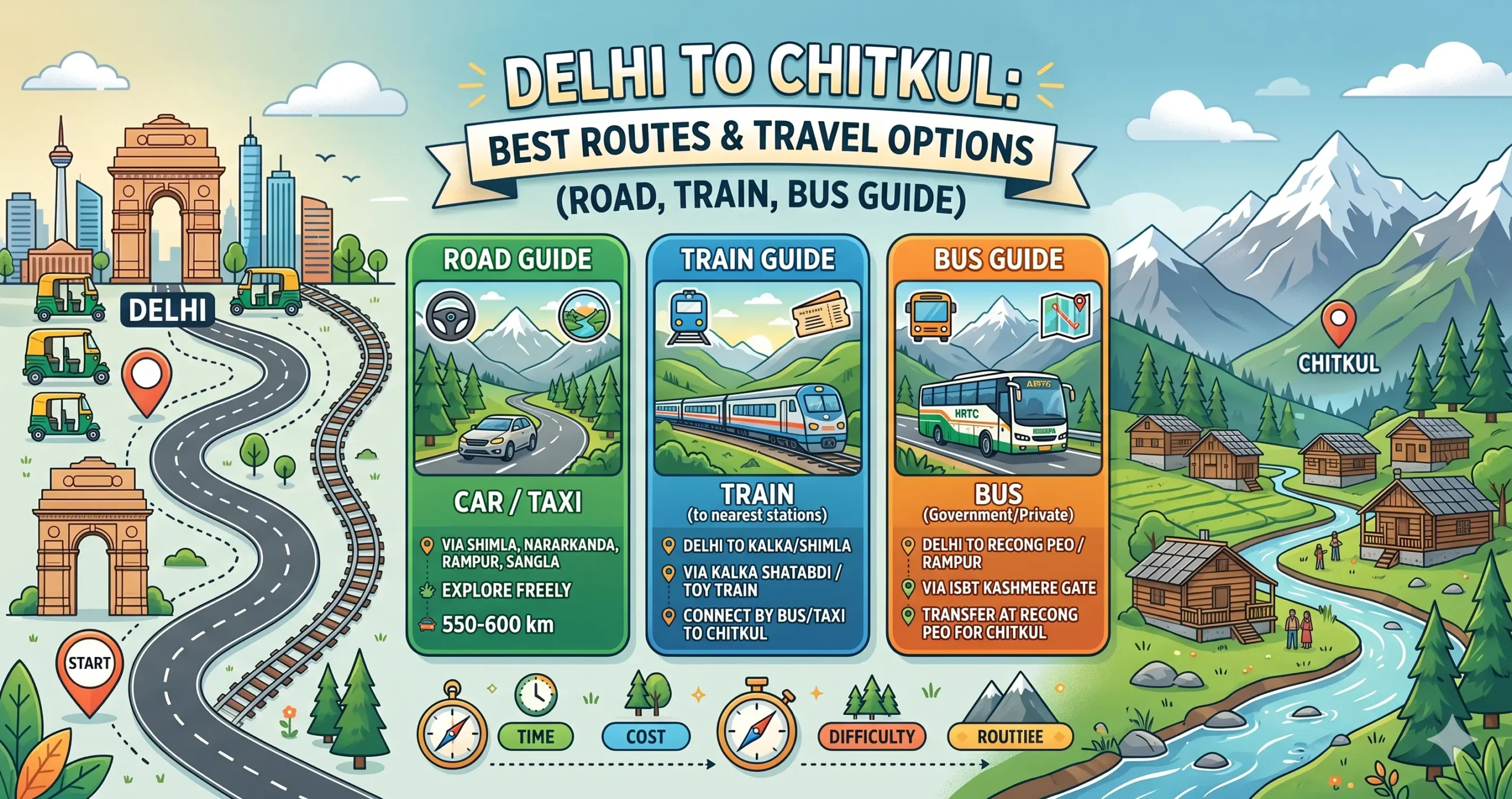
Chitkul is one of the last inhabited villages before the Indo-Tibet border — and one of the most rewarding road trip destinations in North India, known for its snow-capped peaks, the Baspa River, alpine meadows, and distinct Himalayan culture.
The distance from Delhi to Chitkul is approximately 580–600 km, and the road trip typically takes 15–18 hours by car, bus, or a combination of train and road travel. The village sits in the Baspa Valley of Himachal Pradesh’s Kinnaur district, at an altitude of roughly 3,450 meters (11,319 feet).
This Delhi to Chitkul travel guide covers everything you need to plan the trip: the best routes and distances, travel options by road, bus, train, and air, costs, overnight stops, the best time to visit, and essential safety tips for a smooth Himalayan journey.
Quick Facts: Delhi to Chitkul
| Detail | Information |
|---|---|
| Distance | 580–600 km |
| Driving Time | 15–18 hours |
| Elevation | 3,450 m (11,319 ft) |
| Nearest Airport | Shimla Airport (Jubbarhatti) |
| Nearest Railhead | Kalka / Chandigarh |
| Best Time to Visit | April–June and September–October |
| Winter Access | Weather-dependent, can be restricted |
Getting There by Road
Driving remains the most popular and rewarding way to reach Chitkul, since the route itself passes through some of Himachal’s most scenic terrain. There are two well-traveled options.
Route 1: Via Shimla and Karcham (The Main Highway)
This is the standard, most direct route and the one most first-time visitors choose.
Path: Delhi → Panipat → Karnal → Ambala → Chandigarh → Solan → Shimla → Kufri → Narkanda → Rampur → Wangtu → Karcham → Sangla → Chitkul
- Distance: ~580–586 km
- Time: 15–18 hours
The highway is smooth all the way to Shimla, decent through to Rampur, and then narrows considerably as it winds through Kinnaur’s cliffside stretches. The climb from Karcham into the Sangla Valley is steep but manageable with careful driving. Along the way you’ll pass through Shimla, Narkanda, the Sutlej Valley, and finally the Baspa Valley itself — making this the most practical choice for families, groups, and year-round travel.
Route 2: Via Chail (The Quieter Alternative)
For travelers who’d rather skip Shimla’s traffic and enjoy a more peaceful drive, this detour is worth considering.
Path: Delhi → Chandigarh → Solan → Chail → Kufri → Narkanda → Rampur → Wangtu → Karcham → Sangla → Chitkul
- Distance: ~595–600 km
- Time: 16–19 hours
This road runs through quiet cedar forests and rejoins the main Kinnaur highway near Narkanda. It’s slightly longer but far less congested, making it ideal for photographers and those who prefer a relaxed pace.
Route Comparison at a Glance
| Route | Key Stops | Distance | Time | Best For |
|---|---|---|---|---|
| Via Shimla | Chandigarh → Shimla → Rampur → Karcham | ~580–586 km | 15–18 hrs | Most direct, best infrastructure |
| Via Chail | Solan → Chail → Rampur → Karcham | ~600 km | 16–19 hrs | Scenic, low-traffic alternative |
Getting There by Bus
There’s no direct luxury bus service running all the way from Delhi to Chitkul, but the journey is entirely doable in stages using Volvo and HRTC buses.
- Delhi to Shimla/Chandigarh: Overnight Volvo buses depart from ISBT Kashmere Gate, Majnu Ka Tila, and the RK Ashram area. This leg takes 8–10 hours.
- Shimla to Reckong Peo/Karcham: HRTC buses run regularly along this stretch, taking 10–12 hours.
- Karcham/Reckong Peo to Chitkul: Local HRTC buses and shared taxis cover the final leg through Sangla and Rakcham in 2–3 hours.
Total travel time: 18–22 hours
Estimated cost: ₹1,000–₹2,500
This is the most budget-friendly option, especially for solo travelers and backpackers.
Getting There by Train
Chitkul and the wider Kinnaur Valley have no railway station, but you can combine rail with road travel for a more comfortable start to your trip.
Suggested Route
Leg 1: Delhi → Chandigarh or Kalka
Popular trains include:
- Vande Bharat Express
- Shatabdi Express
- Himalayan Queen
Travel Time
3–4 Hours
Optional Experience
Travel on the historic Kalka–Shimla Railway from Kalka to Shimla.
Leg 2: Chandigarh/Shimla → Chitkul
Continue via:
- HRTC bus
- Shared taxi
- Private cab
Total Travel Time
18+ Hours
Verdict
This route suits travelers who’d rather avoid Delhi’s highway traffic and start their trip by rail.
Traveling by Air
Flying can shorten the first leg of the journey, but Shimla Airport has limited connectivity, and the onward drive to Chitkul still takes 9–11 hours. For most travelers, the time saved doesn’t outweigh the added cost and complexity, so road travel remains the more practical choice overall.
Comparing All Travel Options
| Mode | Route | Time | Cost | Best For |
|---|---|---|---|---|
| Self-drive car/SUV | Delhi → Shimla → Sangla → Chitkul | 15–18 hrs | Fuel & tolls | Families, road trippers |
| HRTC + Volvo buses | Delhi → Shimla → Reckong Peo → Chitkul | 18–22 hrs | ₹1,000–₹2,500 | Budget travelers |
| Train + road transfer | Delhi → Chandigarh/Kalka → Chitkul | 18+ hrs | Variable | Comfortable transit |
| Flight + road transfer | Delhi → Shimla → Chitkul | 12–14 hrs total | Premium | Limited practical advantage |
Where to Break Your Journey
Given the length of the drive, most travelers split it over two days. Here’s where to consider stopping:
| Stop | Why Stay Here | Good For |
|---|---|---|
| Shimla | Breaks the journey early | Families |
| Narkanda | Scenic, fewer crowds | Couples |
| Kalpa | Views of the Kinner Kailash range | Photographers |
| Sangla | Closest comfortable base before Chitkul | Most travelers |
| Chitkul | Full immersion in village life | Adventure seekers |
Best Time to Visit Chitkul
Spring and Summer (April–June): Pleasant weather and blooming landscapes make this the busiest and most popular season for sightseeing and photography.
Monsoon (July–September): Landslides and road disruptions are possible. Keep an eye on weather updates and build extra buffer time into your plans.
Autumn (September–October): Crisp air, clear mountain views, and generally stable roads make this one of the best windows to visit.
Winter (November–March): Heavy snowfall can restrict access beyond Sangla. Always confirm current road conditions and pack proper winter gear if traveling during this period.
Practical Tips Before You Go
- Break up the drive. An overnight stop in Shimla, Narkanda, Sangla, or Kalpa helps you avoid fatigue and gives your body time to adjust to the altitude.
- Pack warm layers. Even in summer, nighttime temperatures drop sharply at this elevation.
- Fuel up early. Reckong Peo and Sangla have the last dependable fuel stations before Chitkul.
- Check road conditions in advance. Monsoon landslides and winter snow can both affect accessibility.
- Download offline maps. Mobile coverage becomes patchy in several stretches of Kinnaur.
- Acclimatize carefully. At over 3,400 meters, altitude discomfort is possible — stay hydrated and avoid overexertion right after arrival.
- Carry valid ID. It’s required for hotel and homestay check-ins.
- Carry sufficient cash. ATMs become scarce beyond Reckong Peo.
Mobile Network and Connectivity
Jio generally offers the most reliable signal throughout Kinnaur, with Airtel available but somewhat inconsistent in parts. BSNL can work in a few remote pockets. Internet speeds are limited overall, especially closer to Chitkul, so it’s worth downloading maps, tickets, and other essentials before you set out.
Emergency Contacts
| Service | Number |
|---|---|
| National Emergency Helpline | 112 |
| Ambulance | 108 |
| Himachal Pradesh Police | 100 |
| Roadside Assistance | Contact your insurer |
| HRTC Enquiry | Official HRTC channels |
Traveling Responsibly in Chitkul
Chitkul’s charm lies in its untouched setting, and keeping it that way takes a bit of care from every visitor:
- Avoid littering in and around the Baspa Valley.
- Respect local customs and village traditions.
- Use designated waste disposal points wherever available.
- Keep noise levels down, particularly near homestays and temples.
- Support local homestays, guides, and small businesses when you can.
Final Verdict
The Delhi → Shimla → Rampur → Karcham → Sangla → Chitkul route offers the best balance of road quality, scenery, and reliability for most travelers. Budget travelers can rely on the HRTC bus network, while those who prefer rail can combine a train ride to Chandigarh or Kalka with a road transfer for the rest of the way. However you choose to travel, Chitkul rewards the journey with some of the most striking Himalayan scenery in India.
FAQs: Delhi to Chitkul Travel Guide
1. What is the distance from Delhi to Chitkul?
The distance from Delhi to Chitkul is approximately 580 km to 600 km, depending on the route you choose.
2. How long does it take to reach Chitkul from Delhi?
A direct road journey typically takes 15 to 18 hours. Most travelers prefer breaking the trip into two days for comfort and safety.
3. What is the best route from Delhi to Chitkul?
The most popular route is:
Delhi → Chandigarh → Shimla → Narkanda → Rampur → Karcham → Sangla → Chitkul
This route offers the best road infrastructure and is commonly used by tourists.
4. Is Chitkul accessible throughout the year?
Chitkul is accessible for most of the year, but heavy snowfall during winter can temporarily close roads, especially between Sangla and Chitkul.
5. What is the best time to visit Chitkul?
The ideal months are:
- April to June for pleasant weather and clear mountain views.
- September to October for autumn colors and stable road conditions.
6. Can I drive to Chitkul in a sedan?
Yes, a sedan can reach Chitkul during good weather conditions. However, an SUV with higher ground clearance is recommended due to rough mountain stretches and occasional road damage.
7. Is the road from Sangla to Chitkul difficult?
The Sangla–Chitkul road is narrow and winding in several sections but is generally manageable with cautious driving.
8. How far is Chitkul from Sangla?
Chitkul is located approximately 24 km from Sangla, and the drive takes around 45 minutes to 1 hour.
9. Are there direct buses from Delhi to Chitkul?
No, there are no direct buses from Delhi to Chitkul. Travelers typically take a bus to Shimla or Reckong Peo and then continue via local HRTC buses or taxis.
10. What is the cheapest way to reach Chitkul from Delhi?
The most economical option is:
Delhi → Shimla (Volvo/HRTC Bus) → Reckong Peo/Karcham → Sangla → Chitkul
11. Is there a railway station in Chitkul?
No, Chitkul does not have a railway station. The nearest major railheads are Kalka and Chandigarh.
12. What is the nearest airport to Chitkul?
The nearest airport is Shimla Airport, although it offers limited flight connectivity.
13. Is flying to Chitkul recommended?
Generally, no. Even after landing at Shimla Airport, travelers still need to undertake a long mountain drive of approximately 9–11 hours.
14. How many days are ideal for a Delhi to Chitkul trip?
A 4 to 6-day trip is ideal, allowing enough time for travel, acclimatization, and exploration of Sangla Valley and nearby attractions.
15. Is Chitkul safe for family trips?
Yes, Chitkul is considered safe for families, couples, solo travelers, and groups. Travelers should be mindful of altitude and changing weather conditions.
16. Do I need a permit to visit Chitkul?
Indian citizens generally do not require a permit to visit Chitkul. Foreign nationals should carry valid identification and check current regulations before traveling.
17. Are fuel stations available near Chitkul?
Fuel stations are available in Sangla and nearby towns, but it is advisable to refuel at Reckong Peo before heading deeper into the valley.